
Leasehold Property law. Personally delivered.
Sometimes what you need is not a transaction but an answer. What does this lease actually oblige me to do? Who repairs the roof terrace? Will a lender accept it? Is my landlord the freeholder, or is there somebody between us? We read the documents and tell you, in writing.
Carried out by senior solicitors · Fixed fees from £500 + VAT · Regulated by the SRA · London and nationwide
A standalone piece of advisory work. We read the lease, the title and everything registered against it, and report to you in writing on the question you have asked — with a plain summary of what the documents say, a schedule of anything defective, and a view on what can be done about it.
It is deliberately not conveyancing. There is no chain, no lender and no completion date, which means the reading can be as careful as the question deserves. And unlike the procedural parts of our work, a review is carried out by a senior solicitor from beginning to end — interpretation is judgement rather than process.

A buyer who wants to understand the flat properly rather than take a report on trust, or somebody who has already completed and wants to know what they signed. Frequently a second opinion where a conveyancer’s report raised more questions than it answered.
Who repairs the balcony. Whether the service charge is being apportioned as the lease requires. Whether short-term letting is permitted. Whether consent is needed for the works you have planned.
Whether the lease meets lender requirements, and if not, precisely which provisions fail and what would have to change. Asked by buyers, by sellers preparing to market, and by freehold companies who keep being told there is a problem.
Where the leaseholders own the freehold and are about to grant themselves 999-year leases, that is the one opportunity to correct everything at once — and it repays an audit first.
Not every flat is a simple arrangement between a freeholder and a leaseholder. There may be a head lease, an intermediate landlord, a management company that is party to the lease, or a chain of underleases nobody has looked at in thirty years.
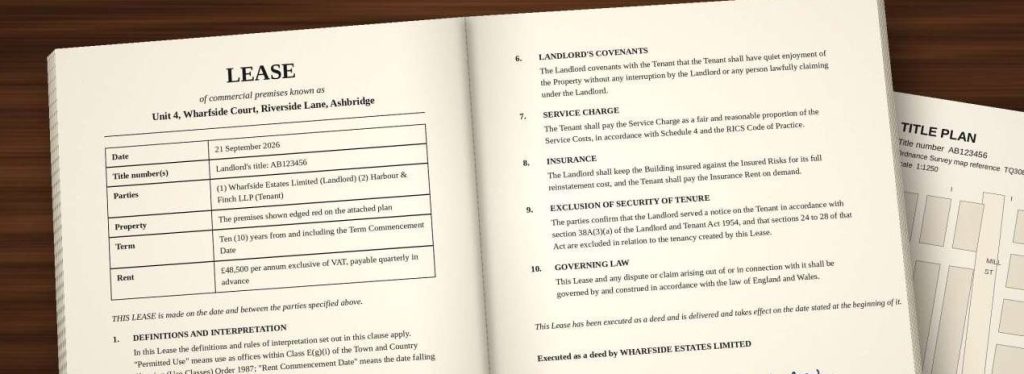
The extent of the demise is rarely obvious and is the question most often answered wrongly. Does the flat include the external walls, or only their internal surfaces? The windows, or only the glass? The frames? The floor screed, the joists beneath it, the ceiling void above? A balcony, a terrace, the loft, the airspace?
Demised, or merely a right to use? Parking spaces, bin and bike stores, garden areas and lofts are frequently not demised at all. A right to use a space is a very different thing from owning it, and it does not become yours through decades of use.
And whether the plan helps. Plans range from properly dimensioned and coloured to a photocopied sketch marked “for identification purposes only”. Where the plan and the words conflict, the outcome is not always the one the picture suggests.
Repair and maintenance. What is yours, what is the landlord’s, and whether the two together account for the whole building. Where they do not, there is a gap — and gaps are discovered when the thing in the gap fails.
Service charges. What is recoverable, on what apportionment, whether the percentages across the building total 100%, whether the landlord may demand in advance and whether a reserve fund is permitted.
Consents. Use, alterations, subletting, short lets, pets, flooring and business use — and whether each restriction is absolute or subject to consent. The difference is a word or two and it decides everything.
Forfeiture and enforcement. What the landlord may do on a breach, and what protections you and your lender have.
Two questions are worth asking about any flat. Where does the demise stop, on the actual wording and the actual plan? And do the obligations account for the whole building — add up what the leaseholders must repair and what the landlord must repair, and see whether anything is left over.
A great many leases were drafted quickly, decades ago, and copied from something older. Ambiguity is common, and the way it is resolved is not always the way a client hopes.
A lease is construed objectively: what would a reasonable person, with the background knowledge available to the parties, have understood the words to mean? Commercial common sense has a part to play, but it does not licence rewriting.
That last point matters more than any other. Where the words are clear, they are given effect even if the result is commercially unattractive to one side — the Supreme Court has said so squarely in the context of a service charge clause that escalated absurdly. A client hoping a court will rescue them from a badly drafted but unambiguous provision is usually hoping for the wrong thing.
Which is why a review is worth having before a dispute rather than during one. If the wording is against you, knowing that early lets you negotiate, vary the lease or budget for the consequence. Discovering it after two years of correspondence is considerably more expensive.
And where a lease genuinely does not work, ambiguity is one thing and a failure to provide for something at all is another. Where a lease makes no satisfactory provision for repair, insurance, services or the computation of the service charge, the Tribunal has power to vary it. Where it simply failed to record what the parties agreed, rectification may be available. Both are narrower than clients hope, and part of the value of a review is establishing which category a problem falls into before anybody spends money pursuing the wrong remedy.
Lenders publish their requirements, and a lease either satisfies them or it does not. Where it does not, the problem can be identified precisely — and usually fixed.
A short unexpired term. Criteria vary between lenders, but caution typically begins where the term falls below ninety years. Separately, once a lease drops below eighty years the cost of extending rises sharply.
Ground rent that escalates. Doubling rents, rents above around 0.1% of the flat’s value, and rents subject to review at intervals of less than twenty years.
No mutual enforcement covenant, so a leaseholder suffering from a neighbour’s breach has no route to a remedy. Defective insurance or repairing provisions. Absolute prohibitions on assignment or subletting with no consent mechanism. Forfeiture without protection for the lender. And in taller buildings, an unresolved building safety position.
What a useful report tells you is not simply that a lease is or is not acceptable, but which specific provision fails, which lenders are likely to take the point, whether it can be cured by a deed of variation or requires a new lease, roughly what that would cost, and whether it is worth doing now or at the next opportunity. For a seller that converts an unquantified worry into a decision; for a buyer it converts a refusal into a negotiating position.
Establishing who owns what above your lease is unglamorous work with disproportionate consequences. It is also frequently the part nobody has done.
What turns on it. Who your landlord actually is for service charges, consents and notices — which is not always the person sending the demands. Which landlord is the competent one for a lease extension or freehold purchase, and whose interest has to be acquired. Whether a head lease is long enough to give you what you need. Whether an intermediate landlord is a dissolved company whose interest has passed to the Crown. And how a premium would be apportioned between the interests.
Where the leaseholders own the freehold and are about to grant themselves new long leases, there is one opportunity to put right everything the old leases got wrong. It is worth taking properly.
Varying a lease later requires the landlord’s agreement, or a Tribunal application on limited grounds, and it has to be done flat by flat. Granting new leases means the company controls the drafting and can adopt a single precedent for the whole building. The marginal cost of doing it well at that point is very small; the cost of not doing it recurs at every sale for the next several centuries.
What an audit typically finds worth fixing: service charge percentages that do not total 100%, and no mechanism to adjust them; repairing obligations that do not match the extent of the demise, leaving parts of the building unallocated; no power to collect on account, no reserve fund and no modern service charge machinery; no mutual enforcement covenant; missing rights of entry, access or services; and nothing at all on short-term letting, electric vehicle charging, building safety cooperation or dispute resolution, because none of it existed when the lease was drafted.
Consistency is the real prize. A building governed by one precedent is markedly easier to manage, to sell in and to fund than one governed by six variants that have drifted apart over forty years.
Where only one lease needs correcting rather than a whole building, a deed of variation is usually the quicker route; where the freehold is not yet in the leaseholders’ hands, that begins with a lease extension or a collective enfranchisement claim.
A review is a defined piece of work with a defined output, which is why it can be quoted as a fixed fee rather than by the hour.
What you want to know. It may be broad — what does this lease commit me to — or a single point. The scope, and the fee, follow from that rather than from the length of the document.
The lease, every deed of variation, licence and supplemental document, official copies of the leasehold and freehold titles and of any intermediate titles, the plans, and the service charge accounts where the question requires them. We obtain what you do not have.
A senior solicitor reads everything and works out what it means, including where the documents conflict with one another or with the position on the ground.
A plain summary of the key terms, the answer to your question, a schedule of any defects with a view on how serious each is, mortgageability where relevant, and options with an indication of cost. Then a conversation to go through it.
Not everything fits a named service, and a good deal of what we are asked to do is a single document or a single question. We are glad to take that work.
Drafting and reviewing assured shorthold tenancies and company lets for landlords and tenants, including where a leaseholder is subletting and needs the tenancy to sit properly beneath the obligations in their own lease.
Where possession is not intended to pass and a tenancy would be the wrong instrument — and advice on whether what you have is in fact a licence, because the label on the document does not decide it.
Deeds of covenant, licences to assign and certificates of compliance, which we prepare routinely for management companies and leaseholders as part of a sale.
Checking that a notice you have received is valid before you act on it, or that one you are about to serve will do what you intend.
For the wider, ongoing running of a building rather than a single document, see block and estate management. And the question that does not have a name: if what you need is not listed anywhere on this website, telephone and describe it. We will tell you whether we can help and, if we cannot, who can.
Most reviews are quoted as a fixed fee, agreed once we know the question and have seen the lease — which is the whole point of defining the scope first. Where a matter is open-ended or the extent of the work genuinely cannot be judged in advance, we work at an hourly rate instead and tell you so at the outset.
Why the scope is agreed first. A review priced by the length of the lease would penalise you for a badly drafted document. Pricing on the question means you pay for the answer rather than for the reading.
Where a review leads to work. If it identifies something worth doing — a variation, a lease extension, a freehold purchase, a new set of leases for the block — we can carry it out rather than hand you a list, and we will tell you what that would cost as part of the report.
And where the answer is that nothing needs doing, we will say so in a short report rather than manufacture a project out of it. A review that concludes there is no problem is a good outcome.

A review is not delegated. The person who reads the lease is the person who reports on it and the person you speak to about it. This is the part of our practice that depends least on process and most on having read a great many leases.
Head leases, intermediate interests, deeds of variation, restrictions on the register and anything noted against the freehold. The lease alone frequently does not tell the story.
A report that summarises a lease clause by clause is of limited use. Ours says what the position is, where it is arguable, and what we would do about it.
Agreed before we start, so the cost of asking a question is known in advance.
Where the review identifies something worth doing, we can carry it out rather than refer it elsewhere.
On Google and ReviewSolicitors, and members of the Association of Leasehold Enfranchisement Practitioners.
A written report on what your lease and title actually say — the extent of your flat, what you must repair, what you can be charged for, what you need consent for, and anything defective. It is advisory work rather than part of a transaction, so the reading can be as careful as the question deserves.
From £500 plus VAT, fixed once we know the question and have seen the lease. Where a matter is genuinely open-ended we work at an hourly rate instead and say so at the outset.
One to three weeks from the point we have the documents, plus a few days to obtain anything you do not hold. Where a deadline is pressing, tell us and we will say whether we can meet it.
That is exactly the question a review answers, and it is rarely obvious. External walls, window frames, floor screed, joists, ceiling voids, balconies and lofts are all treated differently by different leases, and the answer determines who repairs what and whether your works need consent.
Frequently not. They are often the subject of a right to use rather than a demise, which is a materially different thing — it can be qualified, and it does not become yours through decades of use. A buyer’s solicitor will want to know which it is.
Where the aggregate across the building exceeds or falls short of the landlord’s expenditure, the lease fails to make satisfactory provision and the Tribunal can vary it. Where the percentages total 100% but are distributed unfairly, the Tribunal has no jurisdiction and the route is agreement between the parties.
It depends on the unexpired term, the ground rent and several specific provisions. Caution typically begins below ninety years, and lenders object to escalating ground rents, missing mutual enforcement covenants, defective insurance or repairing provisions, absolute prohibitions and forfeiture clauses that do not protect the lender.
Sometimes. Where a lease makes no satisfactory provision for repair, insurance, services or the service charge computation, the Tribunal can vary it. Where it failed to record what the parties actually agreed, rectification may be available. Both are narrower than clients hope, which is why establishing the category first saves money.
Generally not. Where the words are clear they are given effect even if the result is commercially unattractive — the Supreme Court has said so in the context of a service charge clause that escalated absurdly. Hoping a court will rescue you from a bad but unambiguous provision is usually hoping for the wrong thing.
A lease granted by the freeholder out of which the flat leases are granted, so there is an intermediate landlord between you and the freeholder. It affects who you deal with, who must be served on a statutory claim, whose interest has to be acquired and how a premium is apportioned.
Yes. It is the one moment the company controls the drafting and can adopt a single precedent for every flat. The marginal cost of doing it well then is very small, and the cost of not doing it recurs at every sale for centuries.
Yes, and block-wide audits are a substantial part of this work — identifying which defects run through every lease in a building and what can be done about them, priced as one exercise rather than per lease.
Yes. We prepare and review assured shorthold tenancies, company lets and licences to occupy, including where a leaseholder is subletting and the tenancy needs to sit properly beneath the obligations in their own lease.
Whether the price is right, whether the building is sound, or whether the service charge is good value — those are for a valuer, a surveyor and your own judgement. It will tell you what the documents oblige you to do, what they entitle you to, where they are unclear and what a lender is likely to make of them.
Telephone and describe it. A great deal of what we do is a single document or a single question, and we would rather tell you plainly whether we can help — and who can, if we cannot.
If you do not have the lease, tell us the address and we will obtain it. For a block-wide exercise, let us know how many flats there are and whether the leases are thought to be consistent. This enquiry form is deliberately short — one field for your question, which does most of the work — so tell us as much as you can there. We will tell you what the review will cover, what it will not, what we still need to obtain and what it will cost. If the question can be answered in a telephone call, we will say so. The first conversation is at no cost.